

 English
 中文简体
中文简体


Content
The difference between a parasol and an umbrella comes down to what each product is engineered to survive: a parasol is built to endure hours of direct sunlight, while an umbrella is built to shed sudden rainfall and then fold away. That single design goal cascades into nearly every decision a manufacturer makes, from the chemical treatment applied to the canopy fiber to the gauge of steel used in the ribs. A parasol anchored at a beach club or garden restaurant might stay open in the same spot for six or eight hours a day across an entire summer season, so its fabric is chosen for resistance to ultraviolet breakdown rather than for how fast it dries. A rain umbrella, by contrast, spends most of its life folded inside a bag, only opening for the twenty minutes it takes someone to walk from a train station to an office door, so its priorities lean toward quick deployment and water runoff rather than long-term sun endurance. Buyers who treat the two as interchangeable often end up disappointed: a rain umbrella left standing open on a patio all season will usually show visible fading and brittle ribs well before autumn, while a parasol pressed into service as makeshift rain cover during a downpour may pool water at its low points and strain the frame in ways it was never designed to handle.
Why the Two Products Diverged in Design
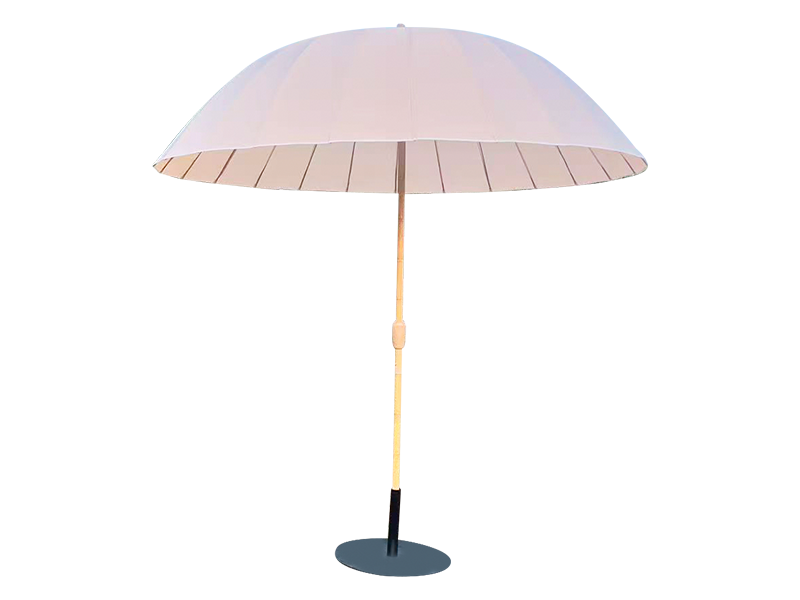
Parasols trace their design lineage back to sunshades used in Mediterranean and Asian markets long before waterproof rain gear existed in its modern form, and that heritage still shows in how they are built today. A garden or market parasol typically mounts through a table hole or into a weighted base, favoring stability over portability, and its pole is often thick enough that a single person cannot comfortably carry it any real distance. Rain umbrellas evolved along a completely different path, shaped by the need for something a pedestrian could carry in one hand, open in seconds, and collapse small enough to fit in a bag. That is why umbrella poles telescope through two or three sections while most parasol poles remain a single fixed length, and why umbrella canopies are cut with a steeper pitch that lets water run off the edge quickly rather than settle across a broad, gently sloped surface designed mainly to maximize shaded ground area. Understanding this history helps explain why comparing the two on price or size alone misses the point; the underlying engineering was never meant to solve the same problem.
Fabric Chemistry and What It Means for Longevity
The fabric coating explains most of the performance gap between a sun parasol and a rain umbrella, and the underlying chemistry is worth understanding before making a purchase. Parasol canopies are frequently made from solution-dyed acrylic, a process where color pigment is mixed into the polymer before the fiber is extruded rather than sprayed onto the surface afterward. This produces a fabric that can resist visible fading for several years of continuous outdoor exposure, with many commercial-grade parasol textiles carrying a UPF 50+ rating, meaning they block roughly 98 percent of incoming ultraviolet radiation. Umbrella canopies take the opposite approach: a base fabric such as pongee or lightweight nylon receives a topical coating, usually silicone or polyurethane, applied specifically to make water bead and roll off rather than soak through the weave. That coating does its job well in a downpour, but constant sun exposure gradually breaks down the coating's polymer chains, which is why a rain umbrella left open outdoors for weeks will start to leak long before its frame shows any wear. Neither fabric is inferior to the other; they were simply formulated to solve different problems, and mixing up their intended use is where most premature product failures originate.
Frame Engineering: Stability Versus Flexibility
Frame design reflects the same split in priorities that defines the difference between a parasol and an umbrella at almost every structural level. Parasol ribs are usually stamped or extruded from steel or aluminum sections thick enough to resist bending under sustained wind load, since a canopy that stays fixed in one place for an entire afternoon needs to hold its shape rather than flex constantly. Many garden parasols also include a crank-and-tilt mechanism inside the pole, letting the canopy angle shift as the sun moves across the sky, and beach parasols often pair with a corkscrew ground anchor or sand auger because a fixed base alone will not hold against gusting coastal wind. Umbrella ribs take a nearly opposite engineering approach, relying on thin, springy fiberglass that bends under a gust and snaps back into shape rather than resisting the force rigidly. This flexibility is precisely why a well-made compact umbrella can survive being turned inside out by wind without breaking, while a rigid parasol frame subjected to the same force is far more likely to crack at a joint or bend permanently out of shape. A vented parasol canopy, which includes a small mesh panel near the crown to release pressure buildup, can typically withstand noticeably stronger wind than a fully sealed canopy of the same diameter, a detail that matters a great deal for anyone specifying shade equipment for an exposed patio or beachfront property.
Size, Scale, and How That Affects Use
Scale is another area where the two products rarely overlap. A residential garden parasol commonly spans 2.5 to 3 meters across, large enough to shade a full outdoor dining table, while commercial parasols used at resorts or restaurant terraces can extend beyond 3.5 meters and require a base weighing 40 kilograms or more just to stay upright in moderate wind. A rain umbrella, by contrast, rarely exceeds 1.2 meters in diameter, since anything larger becomes unwieldy to carry through a crowded sidewalk or doorway. This size difference is not arbitrary; it reflects the fact that a parasol needs to cover a stationary group of people or a fixed piece of furniture, while an umbrella only needs to cover the single person carrying it while they move from one covered space to another.
| Specification | Parasol | Umbrella |
|---|---|---|
| Typical diameter | 2.5 - 3.5 meters | 0.9 - 1.2 meters |
| Canopy fabric | Solution-dyed acrylic, UV-coated polyester | Silicone or PU-coated nylon/pongee |
| Frame rib material | Steel, aluminum | Fiberglass, lightweight aluminum |
| Base or mounting | Weighted base, table hole, ground anchor | Handheld, no base required |
Making the Right Choice for a Given Setting
Someone furnishing a restaurant patio or beach club is generally better served by a parasol carrying a genuine UPF rating and a rib structure rated for the wind conditions of the site, since guest comfort over a full afternoon depends far more on UV blocking and stability than on how quickly the unit opens. A property near open water in particular benefits from a vented canopy and a corkscrew ground anchor rather than a lightweight stand, because gusting coastal wind will eventually topple anything not firmly secured into the ground. Someone shopping for daily commuting needs, by contrast, gains little from a parasol's size or sun rating and instead should weigh rib flexibility and how compactly the umbrella folds, since the product will spend most of its life being carried rather than standing still. Confusing these two use cases at the purchasing stage, whether by a hospitality buyer choosing shade equipment for a terrace or an individual grabbing whatever is on hand during a sudden shower, remains the most common reason either product wears out faster than its warranty suggests it should. Recognizing the difference between a parasol and an umbrella before buying, rather than after the fabric fades or the frame bends, is ultimately what determines whether the product lasts through its intended season of use.