

 English
 中文简体
中文简体



The outdoor shelter industry is undergoing a quiet revolution. High-performance automatic and inflatable tent technology is reshaping what campers, expedition teams, emergency responders, and event organizers can expect from a portable structure — combining aerospace-grade materials, intelligent inflation systems, and precision engineering into shelters that deploy in minutes and withstand conditions that would flatten conventional alternatives.
The Engineering Shift: From Poles to Pressurized Structures
Traditional tent design has barely changed in 60 years. A network of rigid poles — aluminum or fiberglass — supports a fabric shell through a predictable geometry of arcs and cross-braces. It works, but every joint is a weak point, every pole a separate component to assemble, and setup time is measured in minutes at best, often longer in wind or darkness.
Inflatable tent architecture eliminates the rigid skeleton entirely. Air beams — sealed tubes integrated directly into the tent fabric — replace structural poles. When pressurized to between 5 and 9 PSI (34–62 kPa) depending on the design, these beams achieve a stiffness-to-weight ratio that rivals aluminum poles while distributing load across the entire beam length rather than concentrating stress at joints. The result is a structure with no single-point failure mode: a minor puncture causes a gradual, manageable pressure loss rather than a sudden collapse.
An inflated air beam at 7 PSI can support loads equivalent to a rigid aluminum tube of the same cross-section — with roughly 40% less weight and zero assembly joints.
Air Beam Materials and Construction
Modern high-performance air beams use a multi-layer construction. An inner TPU (thermoplastic polyurethane) bladder holds the pressurized air, surrounded by a woven polyester or nylon structural jacket that prevents radial expansion and defines the beam's working diameter. The outer layer, integrated with the tent shell, provides UV and abrasion resistance. Premium systems — particularly those designed for military or expedition use — use Dyneema-reinforced jackets that achieve tensile strengths exceeding 350 kN/m² at a wall thickness under 2 mm.
Automatic Deployment Systems: Intelligence at the Push of a Button
Inflation alone is not the same as automatic deployment. True automatic tent technology integrates pump systems, pressure sensors, and sequenced inflation logic to transition a packed tent to a fully habitable structure with minimal user intervention. This distinction — between "you pump it up" and "the tent inflates itself" — defines the frontier of the technology.
Integrated Electric Pump Architecture
High-performance automatic tents embed compact brushless DC pumps directly into the tent body or carry bag. These pumps — typically drawing between 5 W and 25 W — can be powered by a dedicated lithium battery pack, a vehicle's 12 V outlet, or increasingly, a small solar panel integrated into the tent fly. Pump selection criteria balance flow rate (measured in liters per minute) against noise, weight, and energy consumption.
Sequenced inflation is a key innovation: rather than pressurizing all air beams simultaneously from a single source, smart systems use electronic valve controllers to inflate beams in a defined order that ensures the structure self-orients correctly and roof panels lift before wall panels tension. This prevents the fabric from binding or inverting during deployment — a common failure mode in early inflatable tent prototypes.
Pressure Sensing and Closed-Loop Control
Sophisticated automatic systems integrate MEMS pressure sensors at each beam and a microcontroller that continuously monitors and maintains pressure within ±0.2 PSI of the target value. In cold environments where gas contracts, or warm environments where solar gain causes pressure spikes, the controller compensates by pulsing the pump or venting through a solenoid valve. This active pressure management extends beam life significantly by preventing over-pressure stress fatigue and maintains structural integrity across a temperature range of roughly −30 °C to +60 °C.
- Brushless DC integrated pumps: 5–25 W power draw, <2 kg added mass
- Sequenced multi-valve inflation for correct structural self-orientation
- MEMS pressure sensors with closed-loop ±0.2 PSI regulation
- Temperature-compensated pressure management (−30 °C to +60 °C)
- Automatic leak detection with user alert via Bluetooth app or audible alarm
- Battery, 12 V DC, and solar-compatible power inputs
- Deflation and fold-assist mode for rapid pack-down
Fabric Technology: The Outer Skin as Performance System
The structural innovation of air beams would be wasted inside a mediocre shell. Correspondingly, the fabrics used in high-performance inflatable tents have advanced in parallel, moving away from simple nylon ripstop toward purpose-engineered technical textiles that manage water, wind, condensation, UV load, and thermal performance simultaneously.
Outer Fly Materials
Leading outer fly fabrics for expedition-grade inflatable tents use a laminate construction: a face fabric (typically 40–70 denier ripstop polyester or nylon), a microporous ePTFE or polyurethane membrane, and an inner tricot lining. The membrane is the critical component, providing a waterproof rating of 10,000–20,000 mm hydrostatic head while remaining breathable enough to allow water vapor transmission rates (MVTR) of 10,000–15,000 g/m²/24h. This combination keeps rain out while allowing body moisture to escape, significantly reducing interior condensation.
UV and Thermal Performance
In high-altitude or desert environments, solar UV load can degrade standard polyester fabrics within two or three seasons. High-performance fabrics incorporate UV stabilizers and optical brighteners into the yarn itself rather than as surface coatings, giving them a UPF rating of 50+ that does not wash or wear away. Thermal performance is addressed through selective use of IR-reflective coatings on the inner face of the fly — reducing radiant heat gain in hot climates by up to 30% compared to untreated fabrics.
Floor Systems
The bathtub floor — a sewn-in groundsheet with taped seams that extends up the sidewalls 15–20 cm — is the standard in quality inflatable tents. High-performance models use 150–210 denier polyester or nylon laminated with a PU coating achieving 10,000+ mm hydrostatic head, with all seams heat-taped rather than stitched-and-coated for maximum reliability. Some designs integrate a separate inflatable floor beam that lifts the sleeping area 3–5 cm off the ground, providing additional insulation and a level sleeping surface on uneven terrain.
Application Domains: Where Automatic Inflation Delivers Real Value
Military and Tactical Shelters Mission-Critical
Defense forces were among the earliest adopters of inflatable shelter technology, driven by the operational requirement to establish field camps rapidly under fire or in adverse conditions. NATO-standard inflatable command tents can be erected and operational in under three minutes by a two-person team, compared to 15–20 minutes for equivalent pole-frame structures. Current military-grade systems use CBRN-sealed fabric laminates and positive-pressure filtration to provide collective protection against chemical and biological agents — a capability inherently suited to the sealed, pressurized architecture of inflatable structures.
Disaster Relief and Emergency Response
Following earthquakes, floods, or mass casualty events, establishing field hospitals, logistics hubs, and survivor shelters quickly is a life-safety priority. Inflatable structures — deployed from compact vehicle-mounted kits, pressurized by integrated generators, and operational within minutes of arrival — have become the shelter of choice for leading humanitarian organizations. Their ability to create large, column-free interior spaces (15 m × 15 m and beyond) that can be rapidly reconfigured makes them far more functional than ridge-tent alternatives at comparable deployment cost.
High-Altitude and Polar Expedition Use
Inflatable tents have gained traction on technical mountain expeditions, where setup speed in deteriorating weather can be a survival factor. The absence of poles eliminates the risk of a critical component being lost or damaged during a fall or storm. Advanced expedition models such as those used on Everest permit routes incorporate pressure-compensated beams that maintain structural integrity from sea level to 8,000 m elevation — a pressure differential that would rupture undersized bladders — and use zonal inflation that allows selective venting if a beam is compromised.
Overlanding and Glamping
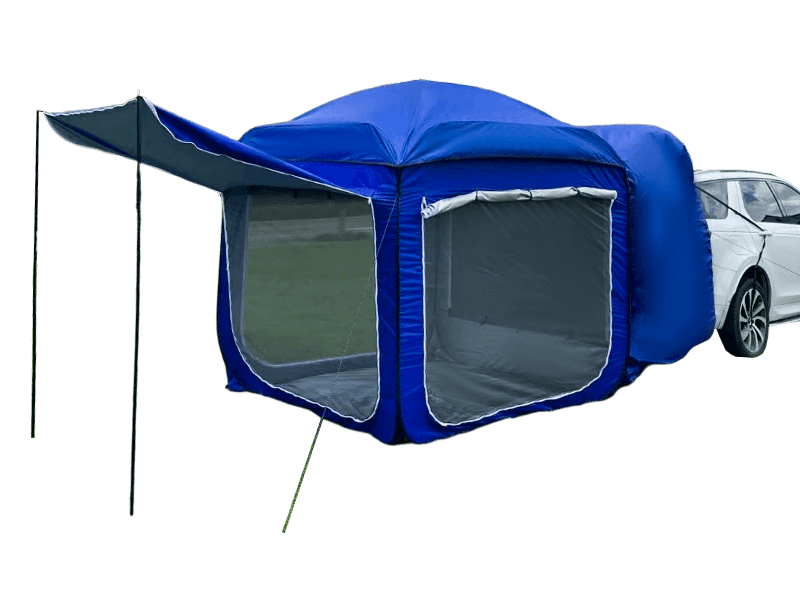
At the consumer end of the market, automatic inflatable tents — particularly roof-top models designed for vehicle mounting — have transformed the overlanding segment. Users who previously spent 20 minutes erecting and tensioning a ground tent now deploy a fully weatherproof shelter in under 90 seconds, with interior space, ventilation, and comfort levels that match mid-range fixed accommodation. The glamping sector has embraced large-format inflatable geodesic domes for temporary luxury hospitality, offering event-quality interiors that are fully dismantlable and relocatable.
Innovation Frontiers: What's Coming Next
Smart Fabric Integration
Research programs at institutions including MIT Media Lab and several European technical universities are developing e-textile outer shells that embed environmental sensors — temperature, humidity, UV index, and wind speed — directly into the woven fabric. Combined with an edge-computing module inside the tent, these systems can automatically modulate ventilation panels, adjust tent orientation via motorized guy lines, or send weather alerts to a user's smartphone. The first commercial implementations — basic LED lighting and power distribution woven into the fly — have already reached the consumer market; full environmental sensing is estimated to be 3–5 years from mainstream availability.
Phase-Change Material Insulation
Thermal regulation in tents currently relies on layering sleeping bags and insulated liners — passive, static systems. Phase-change materials (PCMs) — substances that absorb and release latent heat as they transition between solid and liquid states at a defined temperature — can be microencapsulated and integrated into tent wall laminates. A PCM tuned to 18 °C absorbs heat when the interior warms above that point and releases it when temperatures drop below, dramatically flattening the diurnal temperature swings that disrupt sleep. Prototype tents using Micronal PCM capsules in wall panels have demonstrated interior temperature variance reductions of 8–12 °C in field trials.
Autonomous Deployment Robotics
For military and disaster response applications, fully autonomous tent deployment — requiring no human interaction beyond positioning the packed unit — is an active development area. Prototype systems use a combination of spring-loaded base frames that self-level on uneven terrain, shape-memory polymer components that initialize the structural geometry, and integrated electric pumps that complete inflation and guy-line tensioning automatically once triggered. First operational deployment of such systems is anticipated in specialized military applications within 2–4 years.
The convergence of smart materials, pressure management electronics, and autonomous deployment logic is moving the inflatable tent from a clever camping product toward a class of intelligent, self-configuring infrastructure.
Conclusion: The Case for Pressurized Shelter
High-performance automatic and inflatable tent technology has crossed a maturity threshold. What began as a niche solution for military logistics has evolved into a sophisticated engineering discipline supported by advanced materials science, electronic pressure management, and intelligent deployment systems. The technology's primary limitations — weight and packed volume — are being actively addressed through higher-strength fabric innovations and more compact pump architectures.
For applications where setup speed, reliability in extreme conditions, and structural versatility outweigh the need for ultralight portability, inflatable automatic tents offer a compelling and increasingly proven alternative to conventional pole-frame shelters. As smart fabric integration, autonomous deployment, and thermal management technologies mature, the performance envelope of these structures will expand further — redefining what a temporary shelter can be expected to do.